Kaja Kallas tells of 'frustration' over EU defence industry’s limited ramp up
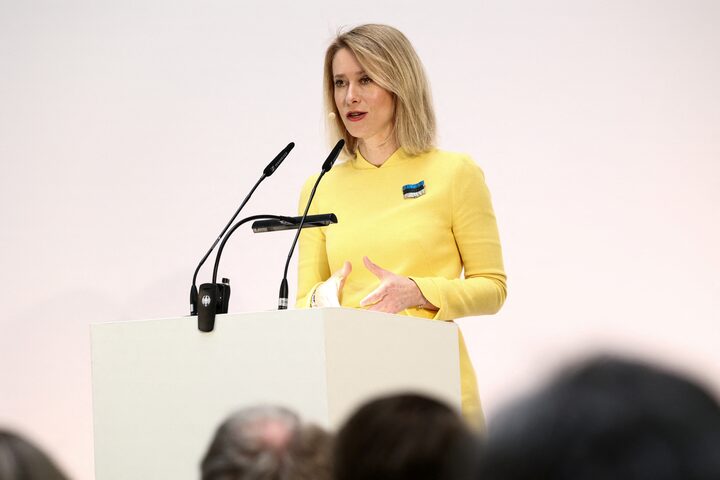
The industry's ramp-up is too slow but countries' needs are growing fast, Kallas said
The EU’s top diplomat Kaja Kallas said on Tuesday she is frustrated over the European industry’s limited progress in boosting arms production despite the war in Ukraine now well into its fifth year.
“We haven’t seen the industry ramping up as we would have expected,” Kallas told reporters after a meeting of EU defence ministers in Brussels.
Ministers discussed how to ramp up defence capabilities and heard from Micael Johansson, the president of the EU’s biggest defence industry association ASD and CEO of Swedish defence giant SAAB.
In a statement after the meeting, ASD said that the industry is “fully committed, capable, and ready to deliver.”
But Kallas had a different take, saying that “countries have a lot of funding on the table but the defence industry is not ramping up their production.”
“We need to see what is the problem,” she added.
The EU has put forward a series of funding schemes to support the defence industry and spur countries to procure jointly.
“Of course, some things have gotten better,” Kallas said, with the production of ammunition, air defence and some critical capabilities now higher than before the war. “The problem is just that the needs have also grown by the member states.”
Ministers raised the need to make progress on the inter-institutional negotiations to change the procurement directive, the EU’s diplomatic chief added.
The Commission last year tabled a series of proposals in its defence omnibus to simplify strict defence procurement rules to fast-track the usual long-lasting procurement procedures, and to ease cross-border transport licenses for defence products funded by EU programmes to combat repetitive delays at intra-EU borders.
MEPs have previously raised frustration over the delays to the defence omnibus files, Euractiv previously reported, after the first trilogue to reach an agreement on the package was pushed back last month.
The ASD also called for accelerating EU instruments, arguing that “harmonised requirements, demand aggregation, streamlined processes” can help speed up production and reduce costs.