Armed Integration: The Half-Open Door to Ukrainian Accession
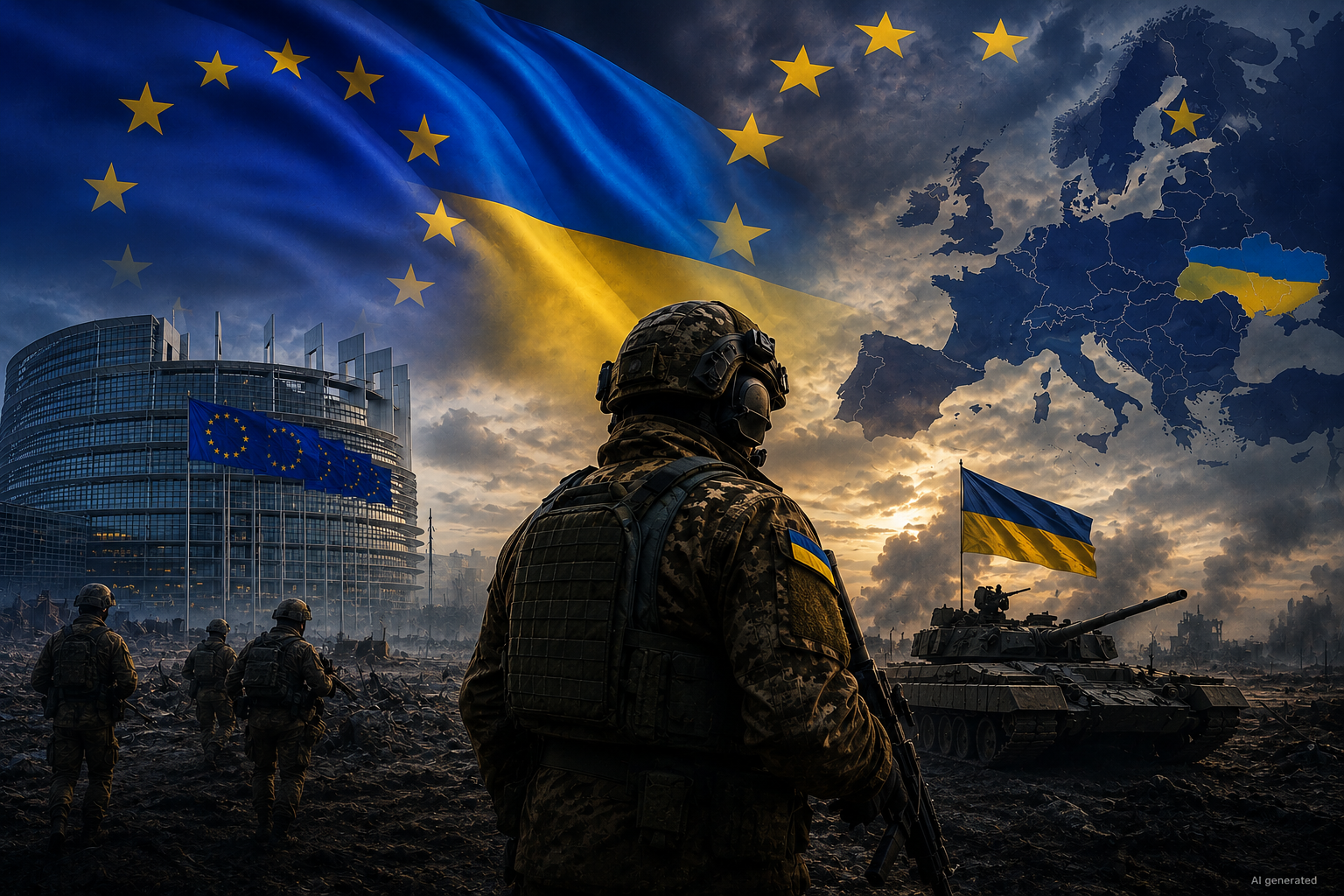
Russia's war in Ukraine and Kyiv's June 2022 candidate status reframed European integration as an operational rather than hypothetical task. By 2026, however, it had become clear that the direct path of accelerated accession faces structural obstacles: the Hungarian veto (largely lifted only after the April 2026 Tisza victory); enlargement fatigue in parts of Western European publics, with Eurobarometer data showing only 43–45% support for further enlargement in Austria, France and Czechia; the fiscal cost of accession (Bruegel estimates an additional €15–20 billion per year in structural transfers) and the unpredictability of the Trump administration's foreign-policy course.
In this context, the concept of Armed Integration – the integration of Ukraine into the European security order without full NATO membership and on a defense-first track – has acquired growing analytical weight. Its causal architecture rests on a triangle: Ukrainian military self-sufficiency as the foundation of security; economic integration with the EU through an EEA-plus arrangement as the foundation of prosperity and regulatory governance and bilateral and multilateral defense-industrial partnerships – PESCO, SAFE, EDIP.
Drivers of Development
Four drivers create the conditions for materialization. First, Ukrainian military self-sufficiency: a defense industry projected at $50–60 billion of output in 2026 (about fifty-five times the pre-war level), drone production scaling from 2.5–4 million units in 2025 to a 7-million target in 2026, and overall capacity up roughly 75% in 2024–25. Second, the EU–Ukraine defence-industrial linkage through SAFE: of the 19 national plans submitted by 2025, 15 included projects with Ukrainian industry. Third, EEA-plus as a deep-integration mechanism that delivers most of the economic gains of full membership while leaving accession on a slower technical track. Fourth, European defence autonomy reinforced by the NATO Hague Summit commitments of 25 June 2025 – 3.5% of GDP for core defense and a further 1.5% for resilience and industrial base by 2035, coupled with continued US disengagement. Each of these drivers is independently observable; together they make Armed Integration the path of least resistance.
Four Pathways Forward
Within the Armed Integration frame, four pathways are visible. They are not mutually exclusive forecasts but plausible end-states between which the actual trajectory is likely to oscillate. The choice is being made, in real time, by negotiations, vetoes and battlefield news.
The Pragmatic Drift – Armed Nonalignment with EEA-plus
If the war freezes along the current contact line – a ceasefire without a formal political settlement – and Kyiv sustains its armed forces at current levels under a constitutionally formalized non-alignment, the most likely outcome is the model articulated by Defense Priorities: Ukraine becomes operationally self-sufficient by around 2030; an EEA-plus arrangement with the Union enters into force a year or two earlier, opening the single market and embedding Ukrainian regulators in the acquis; participation in PESCO and the EDF continues on a non-member basis. This is the analytically purest expression of the doctrine and the most comfortable outcome from the perspective of Brussels' political economy. Its hidden cost, well-known in European studies, is the Turkey trap: deep economic and security integration without political membership tends to stabilize as a permanent intermediate status.
The Helsinki Path – Member State with Its Own Army
The most desirable variant short of accelerated accession is a settlement that does not foreclose the EU path or constitutionalize neutrality. Ukraine retains its accession track, joins the Union and keeps a strong, independent national army; Article 42(7) TEU supplements rather than replaces national capability. The historical analogy is Finland in 1995 – EU accession with a strong national army, NATO membership only later (2023). This pathway eliminates the Turkey risk, delivers the political dignity of membership, locks in the economic gains, and inherits the defense-industrial integration already built up under SAFE and EDIP. It is the outcome a serious EU should be actively engineering.
Defence First – Integration via PESCO Without Accession
A more inverted variant runs the sequence backwards: defense integration precedes economic integration, propelled by EU strategic-autonomy logic and continued American retrenchment. If a future Slovak or Austrian veto blocks EEA-plus negotiations alongside the (now diminished but for how long) Hungarian one, Ukraine could nonetheless be brought into PESCO and EDF programmes without formal EU membership. The result would be a Ukraine that is operationally and industrially a near-member of the European defense ecosystem while remaining politically excluded from the Union's institutions. Strategically robust; politically humiliating.
The Bilateral Fortress – Coalition of the Willing
In the most fragmented scenario the EU collective framework cannot overcome internal vetoes at all. France, Germany, the United Kingdom and Poland – already the principal donors and procurers under SAFE-aligned national plans – conclude bilateral security and economic agreements with Ukraine and become its de facto European anchors. The arrangement would work but it would also weaken the Union as an institution by setting a precedent that the Western Balkans and Moldova would surely note. It is the hardest outcome to govern and the easiest to slide into.
Six Reasons This Suits the EU
Strategic resilience. Armed Integration requires only Ukrainian self-sufficiency and continuous EU financing. The security pillar is thus independent of EU institutional decisions, of Russian behavior and of US multi-cycle commitments – making it uniquely robust under the multi-layered geopolitical uncertainty of 2026–2030.
Decoupling security from Council voting. The security question is resolved through Ukrainian self-sufficiency and defense-industrial integration; no single member state can unilaterally undo this outcome. With public enlargement support running below at only 50% in some member-states, that decoupling is the difference between a track that moves and a track that does not.
Acceleration of European strategic autonomy. EU–Ukraine defense-industrial cooperation generates institutional interest groups in favor of further autonomy. In April 2026 the Commission committed €1.07 billion to 57 EDF projects, with Ukraine-relevant unmanned systems, AI and counter-drone work among the priorities; SAFE's EUR 150 billion envelope is being drawn down by member states under their first-wave plans; EDIP's EUR 1.5 billion programme – including a EUR 300 million Ukraine Support Instrument – opens, for the first time in any EU defense industrial vehicle, calls in which Ukrainian companies are first-class applicants.
Preservation of optionallity. EEA-plus does not foreclose future accession; it builds an acquis baseline from which membership can proceed quickly when political conditions allow. The Egmont Institute's February 2026 brief on “frontloading” describes precisely this logic – technical reforms can advance bilaterally with Ukraine without waiting for unanimous cluster openings.
Security without escalation. Armed nonalignment, formally outside collective military-political alliances, may reduce Russia's strategic-threat perception, which is still in the focus of European strategic view. It is legally and politically distinct from classical neutrality: it permits defense cooperation with third states without formal mutual collective-defense obligations – in principle a compromise format more acceptable in any future negotiation than full NATO membership.
Institutional economy for the EU. Armed Integration does not require accession-related budgetary restructuring, does not trigger CAP redistributive conflicts, and does not require QMV reform or expansion of the own-resources system. The EU obtains most of the strategic gains of integration with Ukraine at a fraction of the political cost of full membership.
Together, these advantages explain why the doctrine is institutionally attractive in the short term: it dissolves the most binding constraints of full accession (member-state vetoes, US unreliability, fiscal uncertainty) while preserving the option value of moving to a more ambitious outcome later. The same logic, however, generates the principal long-term risk – the conditions that make Armed Integration comfortable also make exit from it politically costly.
Six Reasons to Worry
The Turkey trap. The most significant risk is the institutional stabilization of intermediate status – deep integration without membership becoming comfortable for both sides, after which the political momentum for full accession dissipates. The Turkish precedent (Customs Union since 1995, accession negotiations frozen since 2016) shows that this configuration can persist for decades.
Dependence on external defense financing. Armed nonalignment requires sustaining the Ukrainian armed forces at roughly 5–6% of GDP – around EUR 25–30 billion per year, of which Kyiv can cover from its own budget no more than EUR 10–15 billion. Defense Priorities identifies a five-year build-out window during which sustained European financing is critical; any major shortfall erodes the security foundation before formal membership can supply an institutional anchor.
Russian opportunism. Moscow's position is fundamentally ambivalent. Any peace acceptable to the Kremlin is likely to require limits on Ukrainian capability – caps on long-range missiles and ceilings on the size of the armed forces. The 28-point Witkoff–Dmitriev plan circulated in November 2025 included territorial cessions and a ceiling of 600,000 personnel; Chatham House warned that adopting it as drafted would mean Europe's “last chance” to defend the strategic substance of the integration track. Any agreement of that shape would compromise the foundation of Armed Integration.
Internal political fracture in Ukraine. A population that expected full membership and paid a high price for it could turn against a leadership accepting EEA-plus, especially if opponents weaponize the memory of war losses. Public support for EU accession (overwhelming 90% in August 2025) could erode in the absence of a visible accession trajectory; Gallup already records collapsing confidence in the timeline of NATO membership. The “regulation without representation” problem – Ukraine adopting EU rules without participating in their formulation – is structurally present throughout any EEA-plus phase.
EU strategic complacency. If the intermediate status becomes comfortable, the political impulse for transition to membership can dissipate – especially as competing enlargement demands (Western Balkans, Moldova) absorb institutional bandwidth.
Institutional adequacy of EEA-plus. The original EEA was designed for three small states (combined population smaller than an average EU member); extending it to a Ukraine of over 35 million people, major defense industry and significant agriculture requires institutional innovation that has not yet been delivered. The legal nature is also uncertain: as an Article 217 TFEU treaty or a mixed agreement it would require national ratifications – reproducing the unanimity problem the doctrine is designed to circumvent.
Taken together, these constraints do not invalidate Armed Integration but define the active management agenda required to keep it on track. The Turkey trap demands explicit transition criteria; financing dependence demands a multi-annual SAFE successor; the Russian threat demands a coordinated red-line policy on demilitarization demands, and EEA-plus design must be Ukraine-specific rather than a Norwegian template.
From Concept to Strategy
Armed Integration represents an inversion of the classical logic of European integration: security supplied separately from accession, freeing economic integration from the obligation to resolve the security problem simultaneously. Through SAFE, EDIP, PESCO, EDF and EEA-plus it generates institutional interest groups committed to continuing and deepening integration with Ukraine. The doctrine is a working architecture; it should not be allowed to become a destination.
For that, four interventions are required. The Union should institutionalize EEA-plus as an explicitly transitional rather than terminal frame, with built-in automatic review mechanisms (sunset clauses, transition criteria). SAFE should be extended beyond 2035 and integrated into the multi-annual financial framework as a permanent instrument, aligned with the NATO Hague spending trajectory. Article 42(7) TEU must be equipped with operational infrastructure – typified response plans, integrated command, synchronized procedures. And political communication in Kyiv must explicitly describe EEA-plus as an interim, not a final, status, to forestall erosion of public support for European integration.
Armed Integration should not become either a “second-best” option or merely a fallback in case full integration fails. It is an independent strategic concept with its own institutional, financial and geopolitical architecture. Amid the multi-layered uncertainty of 2026–2030 – US elections, electoral cycles in Germany and France, ongoing Russian aggression, and persistent blocking positions inside the EU – it may prove a long-term sustainable model that shapes the contours of European integration for next years. Adequate political engagement with this scenario requires continuous critical analysis, fine-tuning of institutional instruments, and, most importantly, preserving the strategic horizon of full membership as a long-term goal.