We Must Think Beyond the Old Orthodoxy of Enlargement
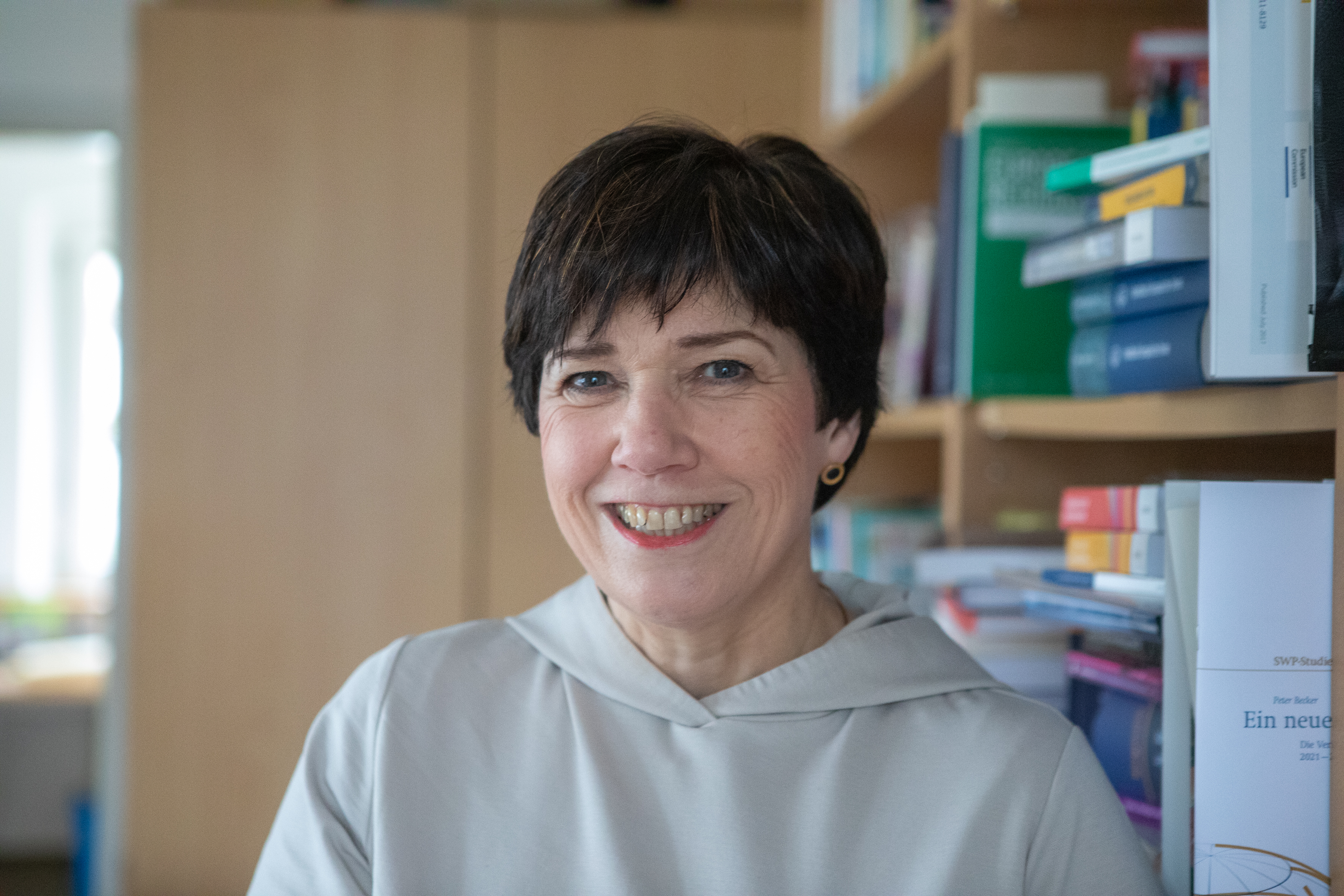
“We Must Think Beyond the Old Orthodoxy of Enlargement”
Interview with Gabriele Abels
Gabriele Abels holds the Jean Monnet Chair of Comparative Politics and European Integration at the University of Tübingen. She is a distinguished scholar specializing in European integration, parliamentary democracy, and multi-level governance. She studied at Marburg University, received her doctorate from the University of Essen in 1999, and habilitated at Bielefeld University in 2006. She has held her chair at Tübingen since 2007 and a Jean Monnet Chair since 2011, served as president of the German Political Science Association (DVPW) from 2012 to 2015, and directed the Jean Monnet Centre of Excellence PRRIDE from 2015 to 2018. She has been a visiting fellow at the European University Institute in Florence, Harvard University and the University of Missouri–St. Louis, and since 2021 has served as a member of the Constitutional Court of Baden-Württemberg.
Professor Abels's research examines the emergence of the European Union as a political system and the conditions of its democratization. She has published widely on regions and parliaments in the EU, theories of European integration, and gender perspectives on European politics. Her recent work addresses the Conference on the Future of Europe and the von der Leyen Commission's relations with the Parliament and the Council, situating current debates on treaty reform and enlargement within the longer trajectory of EU constitutional politics.
O. Kandyuk: "Reform before enlargement" is the formula heard from Berlin and Paris. Yet historically enlargement proceeded without deep treaty reform – 1995 and 2004 both went ahead, and Nice is generally judged a failure that nonetheless did not block accession. What has changed so fundamentally that this path is now considered impossible?
G. Abels: There are, first of all, the Copenhagen criteria. One question is what will happen in the accession countries themselves. But if we set that aside for a moment, the focus shifts to what the EU itself needs to do, because institutional reform of the Union has become an important topic linked to enlargement.
Experience matters here as well: every treaty reform since the 1990s has had reform linked to enlargement on its agenda, more or less. This was supposed to be far more important in the case of the Treaty of Nice, in the early 2000s, when it was clear that the "big bang" Eastern enlargement was approaching. Yet that treaty is widely judged as a failure in many respects, for a variety of reasons. The one always mentioned is that the French, who held the Council presidency at the time, were too selfish and too focused on the national interest, and did not prepare the other member states for what institutional reform would actually mean. And then came the big bang enlargement.
We have now seen that, with such a high number of member states, many institutional procedures have become too tedious, too time-consuming and too full of veto options. Much of that is linked to unanimity: on the majority of issues, decisions in the European Council still have to be taken unanimously. The second key issue is one that nobody expected – at least not so quickly, or on such a dramatic scale: democratic backsliding and the erosion of the rule of law in a few, but a growing number of, member states – to some degree in several of them, and unmistakably in the two most prominent cases, Hungary and Poland.
In this sense, treaty reform is now needed if the Union is to remain capable of acting and of responding to internal and external threats. But the internal threats – democratic backsliding and the state of the rule of law – have become so pressing that everyone understands, if we are heading for a Union of thirty-plus member states, things must change.
O. Kandyuk: If reform really is needed – what part cannot wait until after accession, and what can follow later? How do you draw that line?
G. Abels: At least the majority of the key decisions – above all, how to deal with the unanimity vote in the Council on a range of issues – need to be taken beforehand. If you remain in unanimity mode and add member states, agreement becomes even less likely. Even now it is extremely difficult, because nobody wants to open the Pandora's box of treaty change.
Then there are the comparatively minor issues, which are nonetheless important – the old question of whether every member state must have a commissioner. With twenty-seven we already see that this is not easy. There were good reasons why Lisbon opened the possibility of limiting the number to fourteen, but the smaller member states then insisted: no, we want our own Commissioner. This too is a key issue if the Commission is to keep running as the motor of integration and to push things forward, which will become harder with ever more commissioners.
The European Parliament and the division of seats I would still regard as a fairly minor issue, since there are formulas for balancing it out – though the same question arises for seat allocation in some of the other institutions like the Committee of the Regions. Unanimity, however, lies at the heart of the matter, because the European Council and the Council of the EU are so important, and because the succession of crises has made them even more important still. That is the core.
It has to be linked, in turn, to what can be done in the future to secure and strengthen the rule of law. On that particular issue, the Lisbon solution – Article 7, under which voting rights can be taken away – was perceived as a very strong sword. It turned out to be a rather futile tool, however, so long as it remains tied to unanimity and so long as violators of the rule of law protect one another. It would require a change allowing such decisions to be taken by qualified majority, or even by a higher threshold than qualified majority, but in any case short of unanimity. That has become essential.
The cases in point are, as I said, Poland and Hungary. Despite some of the changes, Poland shows how difficult it is to reverse violations of the rule of law while acting in conformity with the rule of law itself. That is the key issue there, and the reason why it is so difficult to get back onto a different track.
For the candidate countries, corruption raises a further set of issues. What we have seen in Ukraine over the past weeks, and over the past year, with the attempt to change the prosecution of corruption cases, was not a clever performance on the part of President Zelensky, because it was clear that it would raise considerable concern on the side of the European Union, the Commission and at least the majority of member states. It brings to the fore how crucial these rule of law questions are in relation to democratic performance, to corruption and to the sound use of EU funding. For any kind of enlargement, then, it is essential that the instruments securing the rule of law be strengthened. They are not yet strong enough.
O. Kandyuk: Hungary and Poland showed that leverage after accession is weak. What could be written into an accession treaty to avoid repeating that? And would such clauses look like discrimination against a new member?
G. Abels: Once it was clear that Article 7 is not a strong tool, the Union turned to developing softer ones. The rule of law monitoring reports are important, because they also illustrate that there is still room for improvement in the other member states. The German report, for example, contains a number of good and important points. Seen from that angle, this is a problem in many member states, though to very different degrees. Hence, it is a valuable instrument.
The most crucial tool, and the most successful, has been fiscal conditionality: if you do not play by the rules, you do not get the money. It has brought about some change, because the economic situation in the member states concerned, and in Hungary above all, is very difficult. People felt that a great deal of money was going into corruption while too little of the EU's money was reaching them. That was one of the reasons for the change we have recently seen in Hungary.
But this holds only so long as the unanimity rule remains in the background for a number of decisions. Consider how Viktor Orbán, as prime minister, used every decision still requiring unanimity as leverage in order to get hold of some of the EU funding. That is a problem if such deals can still be struck, and if the Commission, for the sake of getting something like a sanctions package against Russia on the road, then gives in to some of Orbán's requirements on funding. This takes us back once more to the unanimity rule, and to the fact that there needs to be a separation, so that these linkages cannot be made. Once an agreement has been reached, it cannot simply be undone weeks later on the grounds that one’s interests have shifted or intentions have been reconsidered. That is where things need to be strengthened. As I said, the unanimity rule is really at the heart of the problems.
O. Kandyuk: Ending unanimity in foreign policy is the most common proposal. Your work shows that formal powers and real influence often diverge. Would QMV change anything in practice – or would the veto come back informally, through blocking coalitions or trade-offs in other files?
G. Abels: You are absolutely right: the formal rules on paper are one thing, and what happens in practice is another. The consensus orientation in the Council of the EU persists. But there is also change: particularly as interests become more divergent and heterogeneous, the trend towards actually using the qualified majority vote is growing, and it will certainly grow further in the future.
It is therefore important, on the one hand, to recognise the need for formal treaty change and, on the other, to use the instruments already contained in the Lisbon Treaty for more differentiated integration – the passerelle or ‘bridging’ clause above all – and to work out how they can be applied more extensively. With the passerelle you still need unanimity in order to activate it, but once that is done, decisions can be taken by qualified majority vote. We are still not at the end of the road in working out where these clauses can be used and where their use would make sense, and thereby in achieving more change by stealth, so to speak, which would not require formal treaty change – something that, at the moment and for the next couple of years, I would assume to be very unlikely. But we should use all the tools that are already there; what they require is much stronger political will.
O. Kandyuk: Staged accession is increasingly discussed as a systemic alternative to full membership. To what extent can it evolve into a stable model of integration rather than a transitional device, and does it risk institutionalising a form of second-tier membership within the Union?
G. Abels: Let me start with the second part of the question. That risk certainly exists, which is why the Eastern European member states in particular are very critical of the idea. If we look back a few years, to the Juncker White Paper on the scenarios for the future of Europe: at that time, before the Russian war against Ukraine, Juncker was not thinking of enlargement, because he considered it unlikely in the near future. Even so, some of the scenarios involving differentiated integration were already read by several Eastern European countries as leading towards a more strongly integrated West European Union, with Germany and France as the core and some other member states more in line with them, and then second-class membership for the rest. The risk is real, and that is why the option was not a very viable one when Juncker proposed it as one of the scenarios.
Under the conditions of the present geopolitical enlargement, however, the calculation changes. Every round of enlargement has had some geopolitical motivation, but this one much, much more strongly, with the war in Ukraine and with the different situation regarding China and the United States. If we do not want to wait until Ukraine has perfectly fulfilled all the conditions for membership – particularly in a situation of war, while preparing for full-blown membership and for transposing the ever-increasing acquis communautaire – then, in order to be credible, we really have to think about alternatives: partial integration into the internal market, into the research programmes or into some other areas, even if this would go hand in hand for a while with sitting at the table but not yet having a vote.
I do see that Ukraine has a problem here, because it would love to have full membership from day one, as quickly as possible. But there are good reasons why on the EU side there is a certain reluctance to do that. There is now Article 42(7) of the Treaty on European Union, that is the mutual defence clause, which is similar to, or as some would say even stronger than, Article 5 of the NATO treaty, with its requirement for mutual assistance, and there is the fear that this could drag the rest of the European member states into a direct military confrontation with Russia, something nobody wants.
This is why it is important to think of a more staggered accession process, one that changes the old paradigm under which you are outside one day and a full member the next, and that puts a longer period before full membership, combining it with instruments of support and of learning. It is telling, for example, that the Committee of the Regions has already offered observer status to Ukraine, to Ukrainian regions – a meaningful step, given that there has at least been some decentralisation in Ukraine, as far as I am aware. What this amounts to is more socialisation: learning how the European Union institutions work, and receiving support, including financial help, in order to prepare for full accession one day, but along a more staggered path. That, I think, is really an important strategy.
And I do see some movement in that direction. The German Chancellor has made such a proposal. A new book recently published by Pierre Mirel, a former EU official who has worked within the Commission, develops proposals of this kind. I would also point to the work of the Franco-German expert group and its reform report, “Sailing on High Seas,” published in 2023. The report identified three key criteria for reform, including the rule of law, and put forward significant proposals for enabling institutional change while remaining within the framework of the existing Treaties. Among other things, it explored ways of introducing a more gradual and differentiated accession process.
O. Kandyuk: The granting of candidate status in 2022 was widely framed as a historic geopolitical gesture. Yet many scholars point to a growing gap between the Union’s enlargement promise and its institutional and political capacity to fulfil it. How profound is this gap, and does it risk undermining the credibility of enlargement as a transformative policy tool?
G. Abels: The credibility issue is a core one. Several accession countries that have remained on the list for years have expressed discontent at the speed with which Ukraine was granted candidate status, noting that their own path had been significantly longer and more demanding before they could secure a place on that list. Meanwhile, the process as a whole now appears to be proceeding at a markedly slower pace. There is a perception that Ukraine is being privileged because of the war, whereas they had to work very hard for it. This matters, because it is so important for the EU to still be respected and seen as a credible actor within the European neighbourhood and also on the more global stage.
So, yes, the EU will have to find a way of not privileging Ukraine – or of not doing what is perceived as privileging Ukraine – while still recognising that the needs for support differ, given the war and all the destruction, and given what will follow once the war has come to an end, hopefully sooner rather than later, and what reconstruction in Ukraine will mean. As the biggest country, with a large agricultural sector, Ukraine would of course require a great deal of the funding, and we want to make sure that it does not go into channels of one kind or another but is actually used for reconstruction and for helping the people.
Many of the Western Balkan countries – which are certainly not rich countries either – see precisely this as real discrimination between the different accession countries and as better treatment for Ukraine. The EU always has to make clear that this is a very different situation because of the war, and that this war is not only about Ukraine – which would be a crucial issue in and of itself – but that it is really crucial for defending the European peace order, and that it is about Europeans and about EU security in general. That is at the heart of the arguments, and in the long run it is also important for the Western Balkan countries.
Serbia, for instance, plays a game of flirting with the EU and flirting with the Russians in order to put more pressure on the EU. That, of course, makes matters quite difficult, and it is certainly another country where we have to watch out for democratic backsliding. So we have to be credible in our commitments, we have to support them, but we really have to make sure that Ukraine is a very particular case because of the war and because of what it means for the EU in general.
O. Kandyuk: Given that Ukraine would rank among the largest member states in both territorial and demographic terms, to what extent would its accession recalibrate the internal balance within the Union?
G. Abels: It would change it. In terms of voting rights – with the qualified majority and the share of the population that enters that double majority counting system – and in terms of what it would mean for the European Parliament and some of the other institutions, Ukraine would certainly have one of the biggest shares. But just as important is what it would mean for funding, and in particular for the allocation of agricultural funds or of cohesion, regional and social funds.
Given the current structure of the Ukrainian economy, as far as we can tell right now, agriculture is still so important. How much that will change remains to be seen – I am just reading the news; I am not an expert on Ukraine in that sense. As long as the war goes on, it will be more and more difficult; it will take years until all the mines are gone from the fields, so there will still be restrictions for a long, long time.
At the same time, we see something quite exciting, or remarkable: the development of the Ukrainian defence industry. At the moment, because the war is becoming more and more of a drone war, developments are taking place that were not foreseeable a couple of years ago, and Ukraine can now bring in a lot of knowledge which would be important for the European, the EU defence industry, or for the national defence industries. That is changing things a bit.
We shall see, too, in which direction industrial development in Ukraine will go at some point in times of reconstruction – how far the old coal mining will give way to other kinds of energy supply, and how all this is going to develop, because in many ways we will need to start from point zero, or almost point zero, depending on where you look and on which industries. A lot is changing, but a lot of money will still need to go into cohesion, regional development and agriculture.
That is something which the less affluent Southern European countries, which still get a lot of the agricultural subsidies, or some of the other Eastern European countries – Poland, for instance, is still strong in agriculture – do not like. But in general, in terms of the balance of power, there will certainly be a shift: Central and Eastern Europe will become more important. And we do not know what we will see in the West. If next year we should have a French president from the Rassemblement National, then that is probably the end of the Franco-German axis as the motor of integration. That would be a dramatic change.
O. Kandyuk: The second von der Leyen Commission operates against a marked rightward shift in the Parliament and several capitals. How far does that shift constrain its ability to drive enlargement forward?
G. Abels: You are right: when you compare von der Leyen I to von der Leyen II, there is a remarkable shift in many ways, because we see more centre-right or even right-wing populist governments in power in EU member states. This affects the composition of the Council, and we see some of that in the College of Commissioners, where there is now a stronger, larger number of commissioners from the European People's Party and some from the European Conservatives and Reformists. And we certainly see it in the European Parliament with three right-wing populist or even extremist group, the ECR, the PfE and the ESN, which are united by their Euroscepticism.
At the moment it is already much more difficult for the Commission to anticipate what the majorities in the Parliament could be for its proposals. On most proposals for legislation it is still the centrist parties – the so-called Ursula platform of conservatives (the EPP), social democrats and liberals (Renew), joined, depending on the issue, by the Greens – which carry them. But on the other hand, we have seen that von der Leyen tried to be on friendly terms with Meloni, for the European Conservatives and Reformists. And we certainly see that Manfred Weber, as the leader of the EPP political group, is willing and is actually searching for alternative coalitions, all the way to the far right with the Patriots for Europe. Sometimes even the German AfD, leading the Europe of Sovereign Nations group, is on board – which in Germany would not be possible that easily. Nor is he willing to act on these majorities not only on resolutions, which are non-binding, but increasingly also when it comes to legislation.
That brings a certain challenge for the Commission as to which majorities in the Council and which majorities in the Parliament it can seek. And under these conditions, what I see is really a shift in this Commission. Securitisation has become much more important, and we see that reflected in all the current debates about the multiannual financial framework 2028-2034: there are far more security issues, and they are closely linked to the question of competitiveness. That has become so crucial now, and a lot of the von der Leyen I achievements are being reversed: we had the Green Deal under von der Leyen I, and now it is the Green Industrial Deal, with an emphasis on industrial competitiveness.
This is because the geopolitical and the geoeconomic issues are so much interlinked, and so many of the geoeconomic issues become really weaponised – the whole energy sector, for instance. And of course the war that President Trump started, together with Netanyahu, against Iran does not help, in terms of what it means for the global economy and for the Europeans in particular. So the Commission President is operating under very different conditions and has to seek new majorities in order to get things done. The agenda has certainly changed quite a bit towards security and competitiveness. That is at the heart of current policies.
O. Kandyuk: And the last question, If I asked you to draw up three or four scenarios of possible relations between the EU and Ukraine in terms of integration, what would they be?
G. Abels: The most optimistic scenario would be an end to the war in due time, very shortly. That would then open the route to full-blown accession talks and to accession, let us say, in 2030.
The most pessimistic one, on the other hand, would be that the war continues and continues, because the Russian president does not feel a need to end it, and because there is still not sufficient support for Ukraine. As long as it is going on, there will be no membership, and the accession talks will remain at a lower, more technical level.
The probably most likely one is something in between: a bit of muddling through, with some stronger commitments and options for a somewhat more staggered approach, but with a lot of that probably at a lower level, so that it is not so politicised and cannot be used against the EU with regard to the credibility issue by the other accession countries.
So I would assume that certainly by 2030 we will see a change in membership, that the EU will have seen some change, and that this staggered approach will probably need to go hand in hand with more differentiated integration – more of "let us see who is part of the coalition of the willing and capable", in many ways still open to all member states. But in order to get things done, we must think beyond the old orthodoxy of enlargement and have to think of more staggered, differentiated approaches.